2026-08-27
Robotic Assembly Built for Production
From part variation to cycle time and quality control, see what separates a robotic assembly concept from a system built for production.
Topics
Robotic assembly can handle more variation than it could a decade ago.
Machine vision can locate parts that aren’t presented in the same position. Flexible feeding can accommodate families of components. Force control can help manage insertion and press-fit operations. Automated fastening systems can verify torque. Automated inspection can confirm critical assembly characteristics before a product moves downstream.
These capabilities are expanding the range of processes manufacturers can consider for automated assembly.
But more capable technology doesn’t necessarily make the engineering easier.
Just because an automated assembly system can accommodate more variation doesn’t mean it should. Every layer of flexibility introduces tradeoffs in cycle time, complexity, controls, tooling, validation and maintainability.
The goal isn’t to build the most flexible automated assembly line possible. It’s to determine where flexibility creates value, where repeatability matters more and how every part of the assembly process needs to work together.
For industrial engineering leaders evaluating robotic assembly solutions, that’s where the real work begins.
Flexibility vs. Repeatability
Dedicated assembly automation gets a bad rap sometimes because it isn’t flexible. But flexibility shouldn’t be the goal by default. For the right process, repeatability is exactly the point.
If a manufacturer is producing the same component at a high volume, a dedicated fixture that positively locates a component may be faster, simpler, and more repeatable than using machine vision to find it every cycle. Hard automation can remove variables. Dedicated feeding can deliver components at a predictable rate and remove variables from the process.
When product mix increases, the equation changes.
Vision-guided picking, flexible feeding, programmable tooling and recipe-driven controls can allow the same automated assembly system to accommodate multiple products or component families without dedicated equipment for every configuration.
The tradeoff is complexity. For many applications, the best solution is somewhere between the two.
A hybrid system might use dedicated tooling where repeatability is critical while using vision to accommodate variation in part presentation. Common operations may be automated while highly variable or lower-volume tasks remain manual. Tooling may be designed around defined product families rather than every conceivable future configuration.
The same thinking applies to part variation.
Machine vision can compensate for changes in position and orientation. Force sensing can identify unexpected resistance during insertion. An automated screwdriving system can verify whether a fastener achieved the required torque.
But there are limits to what automation should be expected to accommodate.
If a simple fixture can eliminate a variable, adding sensing may only create unnecessary complexity. If incoming components vary beyond what the assembly process can reliably tolerate, better automation may simply mask an upstream problem.
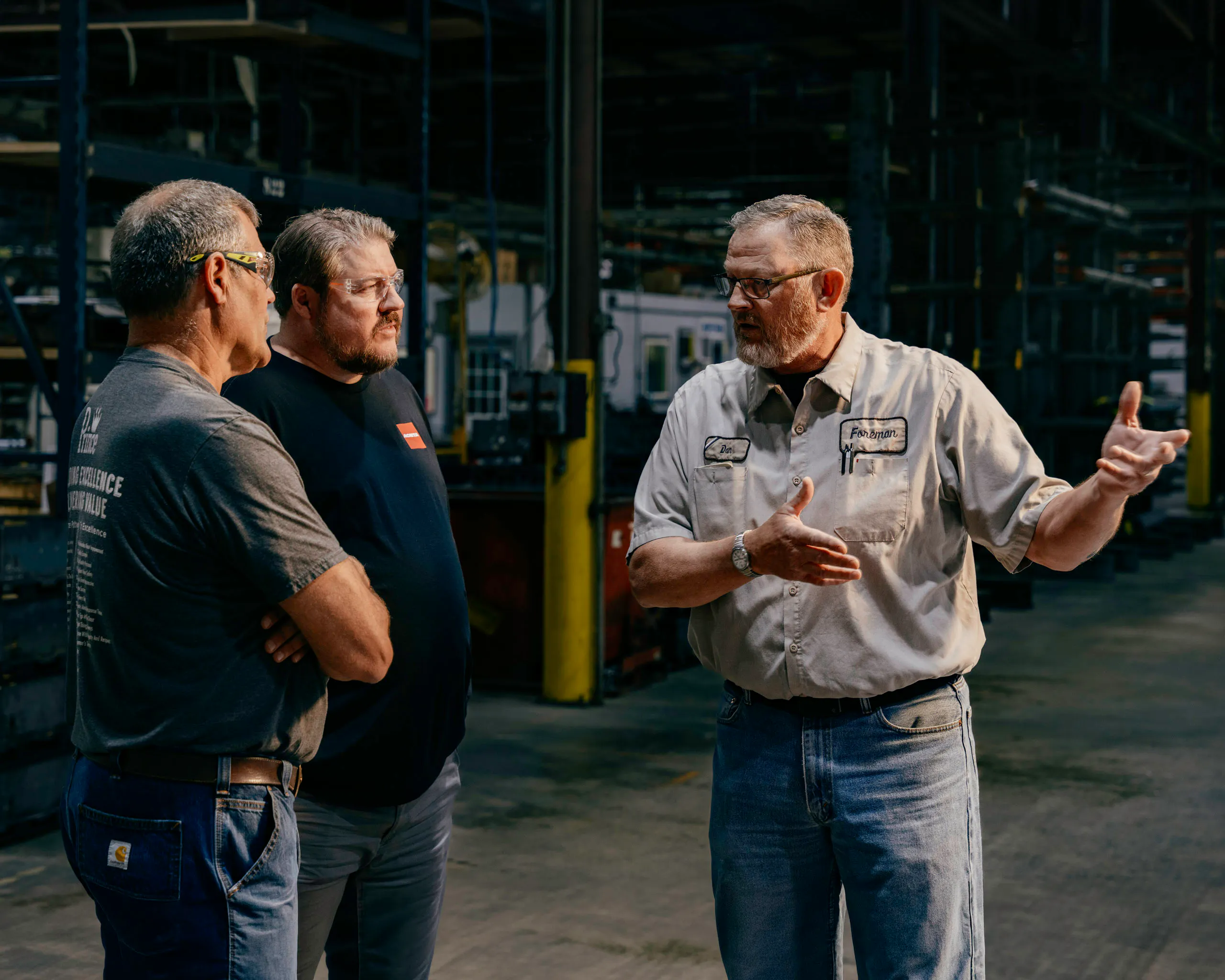
The engineering decision is determining which variation should be controlled and which variation the system should be designed to accommodate. That starts with the people who know the process.
“The people running the process know where the variation is and where production struggles. Our job is to combine that knowledge with the right engineering and technology to create a better process.”
Kent Colclazier
GM, Acieta | Shelbyville
That process knowledge helps establish the boundaries the automation needs to work within. Where does variation actually occur? Which conditions happen every shift versus once a month? Where is consistency critical, and where does flexibility add real value? Those answers help determine whether the right approach is dedicated, flexible or somewhere in between.
The right question isn’t How flexible can we make this system?
It’s How much flexibility does this manufacturing process really need?
Cycle Time is a System Requirement
Robot speed gets a lot of attention when evaluating robotic assembly solutions. But the fastest robot doesn't necessarily produce the fastest system.
Cycle time is determined by the complete assembly sequence.
A component has to be presented and oriented. The robot has to pick it. The product may need to be fixtured. A fastening, pressing, adhesive dispensing or joining operation has to occur. The result may need to go through automated inspection or testing. Then the assembly has to move downstream.
Each of those operations has its own process time.
An adhesive dispensing system may be governed by the required bead geometry and flow rate rather than robot velocity. Automated screwdriving depends on fastener presentation, engagement and rundown time. Leak test equipment may require a defined stabilization and test period that can't simply be accelerated.
The engineering opportunity is often in how those processes are sequenced.
Can the next component be presented while the robot is assembling the current one? Can inspection occur in parallel with another operation? Can work be balanced between stations? Would two simpler stations outperform one highly complex station?
Those decisions determine whether the system can sustain the required rate, not just achieve it for a few cycles during testing.
A system that looks faster on paper isn't necessarily the one that will produce more good parts over a shift.
As the old adage goes - slow is smooth, smooth is fast.
In automated assembly, the point isn't to design a slow system. It's to design a stable one. Sustained speed beats occasional speed.
Build Quality into the Assembly Process
A completed robot motion doesn't necessarily mean a successful assembly.
A fastener can be installed without reaching the correct torque. A press can reach its programmed position without the component seating properly. An adhesive bead can be present but incomplete.
That's why quality control automation increasingly happens within the assembly sequence rather than only at the end.
Automated fastening can monitor torque and angle. Pressing operations can capture force and distance throughout the stroke. Automated inspection systems can incorporate machine vision, dimensional measurement, adhesive verification, leak test equipment and functional testing.
The objective is to verify the characteristics that define a good assembly, and identify a problem as close as possible to the operation that created it.
If a press-fit operation falls outside its acceptable force-distance window, there’s little value in continuing to add components before discovering the defect at final inspection. Inline inspection gives the system an opportunity to identify that condition immediately and determine what happens next.
That information also needs to move with the product. Once a failed operation is identified, the controls can prevent additional processing, route the assembly to reject or rework, and communicate its status to downstream equipment. If traceability is required, inspection results, torque values, force distance curves and test results can be associated with the individual product or serial number.
The result is more than automated quality inspection. The assembly line begins building a record of what good looks like and where a specific assembly deviated from it.
The important questions isn’t how much data can the system collect. It’s which data helps the system make the right decision now, and helps engineering teams make a better one later.
The Right Solution May Be Dedicated, Flexible or Hybrid
There isn't one architecture that defines a good robotic assembly system. Different manufacturing requirements and environments lead to different automated assembly solutions.
Machine vision, flexible feeding, force control, automated fastening, adhesive dispensing systems, and automated inspection continue to expand what’s possible in robotic assembly.
The harder question is deciding where each belongs.
That’s ultimately the role of the system integrator, which is why we always start with understanding your process rather than prescribing a tech stack.
“When we bring our customers' process knowledge together with our automation experience, we can create something really powerful."
Brandon White
EVP Sales + Marketing, Acieta
There’s no single formula for the right automated assembly solution because system integration isn’t an off-the-shelf product. It’s an engineering process.
The best systems come from bringing the right technical expertise together with the people who know the process firsthand then engineering around the parts, production volumes, product mix, quality requirements and where production is headed next.
The result may be dedicated automation, a highly flexible system or, often, something in between.
Real Projects. Real Results.
There’s no standard formula when designing an automated assembly line. The right approach depends on the product, process, production requirements and where automation can create the most value.
The examples below show that range in practice, from high-speed, vision-guided assembly to purpose-built hard automation. Different challenges, different technologies and different automated assembly solutions engineered around the process.
Transfer Case Assembly + Inspection Cell
Acieta engineered a five-station automated assembly and inspection cell that combines robotic handling, hydraulic bushing press, leak testing and inline dimensional inspection into one integrated process.
The system maintains a 30-second station cycle time while providing 100% inspection of critical assembly characteristics.
Rather than waiting until the end of production to identify a defect, quality is built into the process. Press force and distance are monitored during bushing installation, front and rear pressure decay testing verifies leak integrity, and inline inspection measures 16 dimensions and attributes.
Results are captured and displayed through real-time SPC, giving operators and engineering teams visibility into process performance as parts move through the cell.
Read the full story here.
Semi-Trailer Sidewall Assembly
Installing 1,500–3,000 rivets per trailer sidewall was a repetitive, labor-intensive process.
Acieta engineered a pneumatic hard automation system that increased production rates and reduced labor content without using a single robot.
The system installs up to 140 rivets per sidewall post in less than 20 seconds, with 98–99% accuracy.
For this application, adding robotics would have introduced complexity the process didn't need. A purpose-built pneumatic system provided the speed and repeatability required while keeping the solution simple, maintainable and cost-effective.
It's a good example of why the technology should follow the process — not the other way around. Sometimes the right automated assembly solution is flexible robotics. Sometimes it's hard automation.
Read the full story here.